
Water Damage Restoration in Mesa, AZ
Emergency water extraction, structural drying, mold remediation, and mold inspection across the East Valley — 24/7, IICRC certified, crews on site within 60 minutes.
Mesa Water Restoration is Mesa's water damage restoration company, specializing in emergency water extraction and structural drying, mold remediation, and mold inspection and testing. We serve Mesa, Gilbert, Chandler, Tempe, Queen Creek, San Tan Valley and Apache Junction, with 24/7 emergency response and direct insurance billing. Work performed by Drip Restoration, ROC #324316.
Water Damage Restoration Services in Mesa
The core of our work is emergency water extraction and structural drying, performed to IICRC S500. Mold begins colonizing wet material in 24–48 hours, so the same-visit response is what keeps a Category 1 loss from becoming a Category 2 — and keeps the bill down with it.
Emergency Water Extraction
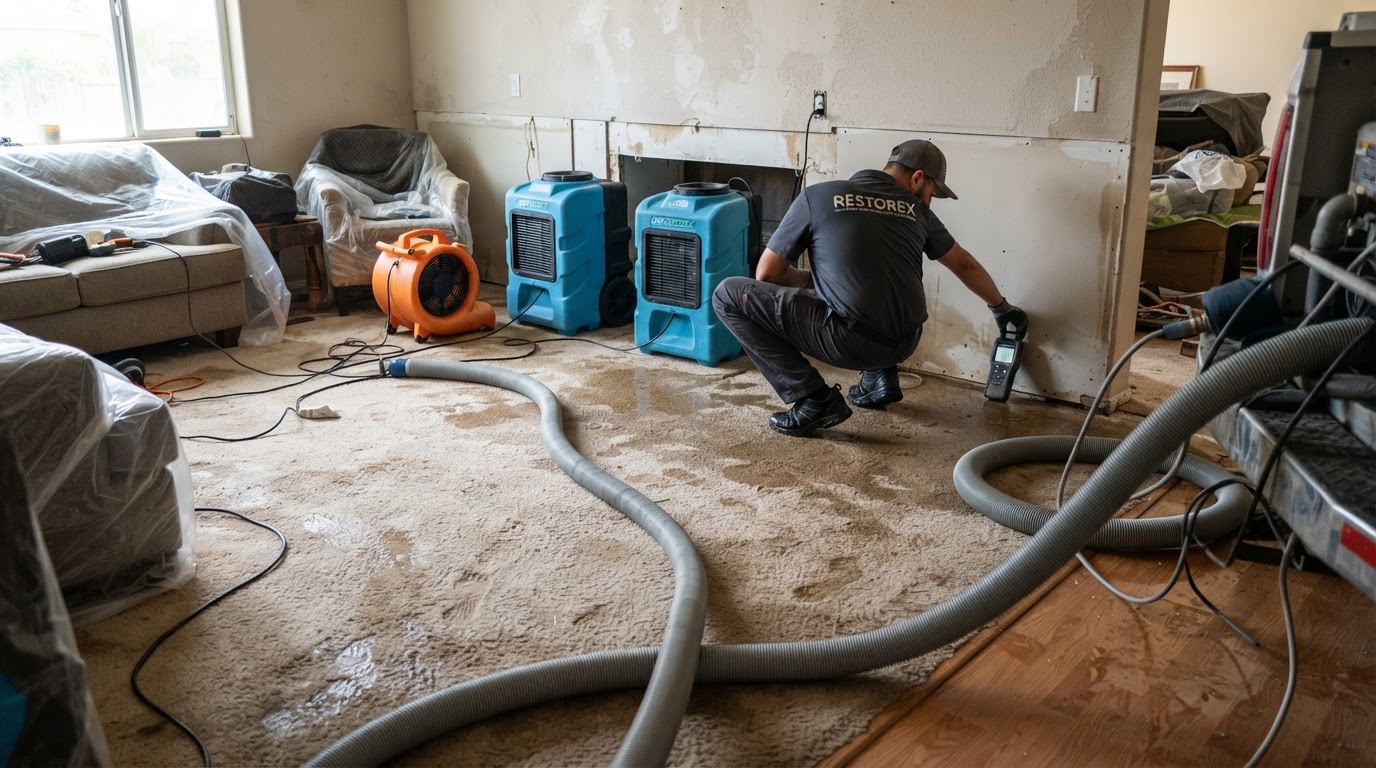
Truck-mounted extraction units and submersible pumps remove standing water the same visit, with crews on site within 60 minutes.
Structural Drying & Dehumidification
LGR dehumidifiers, desiccant units, and axial and centrifugal air movers hold a drying gradient for 3–5 days, verified with moisture meters.
Burst Pipe & Supply-Line Damage
Braided connector failure, polybutylene fittings, and pinhole copper — diagnosed, extracted, and dried down to the slab.
Ceiling & Drywall Water Damage
Roof penetrations, second-floor supply lines, and AC condensate tracked with thermal imaging; wet drywall cut back and dried or replaced.
Slab Leak Water Damage
Moisture mapping with penetrating and non-penetrating meters to locate under-slab leaks before extraction and drying.
Water Heater Failure Cleanup
Tank and pan failures, drain-line backups, and garage-versus-interior flooding scopes handled with contents pack-out.
Carpet & Pad Extraction
Weighted extraction tools pull water from carpet and pad; antimicrobial application prevents odor and microbial growth through the drying cycle.
Moisture Mapping & Thermal Imaging
Penetrating and non-penetrating moisture meters plus thermal imaging document the wet envelope and confirm drying standard for the adjuster.
Mold Remediation and Inspection in Mesa
Mold work is governed by IICRC S520. We contain the affected area with six-mil polyethylene, run HEPA-filtered negative air machines and air scrubbers, HEPA-vacuum and antimicrobial-treat non-porous surfaces, and remove porous material with drywall cut back 12–18 inches beyond visible growth. Post-remediation third-party clearance testing verifies the job before reconstruction.
We identify by species where it matters — Stachybotrys chartarum (black mold), Aspergillus, Penicillium, and Cladosporium — and separate mold inspection and air sampling from remediation so the assessment and the fix never come from the same invoice.
Mold Remediation & Removal
Containment, HEPA filtration, antimicrobial application, and third-party clearance testing performed to IICRC S520. Black mold removal and species-specific scopes.
Learn moreMold Inspection & Testing
Visual inspection, moisture mapping, spore-trap air sampling, and surface sampling with accredited third-party lab results you can act on.
Learn moreActive water loss? Every hour changes the scope and the bill. Call now — crews on site within 60 minutes.
(480) 555-0123Our Process, Hour by Hour
A concrete timeline, not a vague four-step graphic. Response time changes the scope and the bill — here is exactly what happens and when. For the full process, categories, and cost detail, see our water damage cleanup and repair page.
Within 60 minutes
Inspection and moisture mapping. We arrive, locate the source, map the wet envelope with penetrating and non-penetrating meters and thermal imaging, and photograph everything for the adjuster.
Same visit
Extraction begins. Truck-mounted units and submersible pumps remove standing water; weighted extraction tools pull water from carpet and pad. Antimicrobial applied to wet materials.
Day one
Equipment placement. LGR dehumidifiers, air movers, and negative air machines positioned to hold a drying gradient. We log baseline psychrometric readings — grains per pound, relative humidity, temperature.
Days 3–5
Monitored drying. Daily moisture logs and psychrometric readings track progress; equipment is repositioned as zones hit drying standard. We document continuously.
Moisture verification
We confirm the structure is at drying standard with moisture meters before any reconstruction. Deliverables: daily moisture logs, psychrometric readings, and photo documentation for the adjuster.
Repair scope
With the structure dry, we hand off the reconstruction scope — drywall, flooring, baseboard, paint — as a separate line item from mitigation.
Why Mesa Homes Flood
The differentiator. Almost nobody on page one covers this — and it is the actual reason our phone rings. Water damage in Mesa is a housing-stock problem before it is a weather problem.
Slab leaks driven by expansive clay soils across Maricopa County that shrink and swell with the seasons, putting lateral stress on embedded pipe. Shallow ground temperatures above 120°F in summer accelerate deterioration of pre-1990 copper, which is the most vulnerable stock. Read about slab leaks in Arizona.
Polybutylene pipe from late-1970s to mid-1990s construction failing brittle at the fittings — not the pipe itself, the crimp fittings that oxidize and weep. How to identify polybutylene.
Pinhole corrosion in original copper slab lines; galvanized line corrosion in older neighborhoods; hard-water scaling that narrows lines and raises internal pressure until a fitting lets go.
Braided supply connectors under sinks and behind washing machines — the small, cheap part that floods the most houses. Why Phoenix pipes really burst.
The housing stock
Mesa is 70.3% pre-2000 housing with a median build year of 1989. The 1980s cohort alone is 53,402 homes — which is exactly the stock now failing. The age of the plumbing is the actual driver of water damage in this metro, and it is why our calls concentrate where they do.
Areas We Serve
Seven cities across the East Valley, each with its own housing-stock profile and failure modes. Crews on site within 60 minutes of the call.
Mesa
Mesa's pre-2000 housing stock — 70.3% of homes, median build year 1989 — is exactly the cohort now hitting polybutylene and pinhole copper failures, and it's where most of our slab-leak calls originate.
Gilbert
Homes hitting the 20-year mark — original water heaters at end of life, first-generation braided supply connectors, builder-grade angle stops. Newer stock means newer failure modes.
Chandler
Split stock: 1990s homes with aging copper and galvanized alongside post-2000 builds. Two different failure profiles live in one city.
Tempe
Older core stock plus dense rental and student housing — landlord and property-manager work where rapid tenant coordination matters.
Queen Creek
The newest stock in the Valley — and real flood geography. Queen Creek Wash and Sonoqui Wash carry monsoon flash flooding; new-construction defects round out the calls.
San Tan Valley
A single decade of stock, now 17–27 years old, hitting the supply-line and water-heater failure window together. San Tan Valley incorporated 17 Sept 2025 — a genuinely new municipal entity.
Apache Junction
Oldest and lowest-value stock of the six — galvanized lines, original copper, manufactured-home plumbing. Lower average tickets, but a higher share of genuine emergencies.
Monsoon Season and What Insurance Covers
Monsoon
The NWS monsoon window runs June 15 – September 30, peaking mid-July through August, delivering about 2.56 inches — roughly a third of annual rainfall — via microbursts, haboobs, and flash flooding. A single inch in under an hour can overflow washes and pool on flat roofs. Monsoon water damage in Mesa.
Insurance
Most water-damage claims turn on the sudden-and-accidental versus gradual distinction — that is what decides the file. Sewer and drain backup needs a separate endorsement. Filing a water damage insurance claim in Arizona.
Frequently Asked Questions
Mold begins colonizing wet cellulose material in 24–48 hours. The dry desert climate does not prevent it — the moisture inside a wet wall cavity is what matters, not the outdoor dewpoint.
Get a free assessment today
Whether it's happening right now or you found a stain this morning, our crew can be on site within 60 minutes. Call the emergency line or send a few details and we'll call you back.
Call (480) 555-0123